Actor · Writer · Producer
Jude Bramwell
Based in Cumbria. Comedy and drama, in front of and behind the camera.
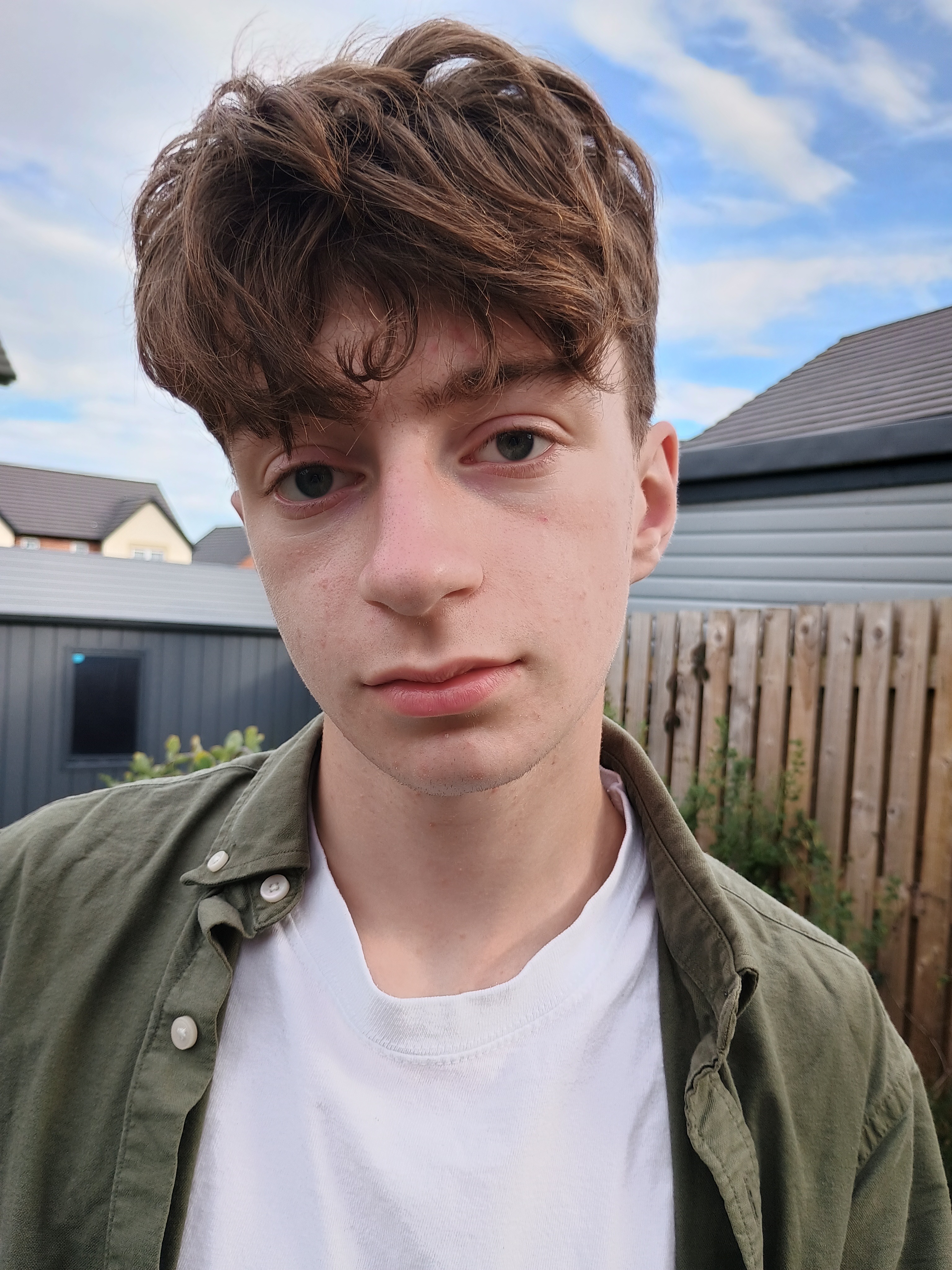
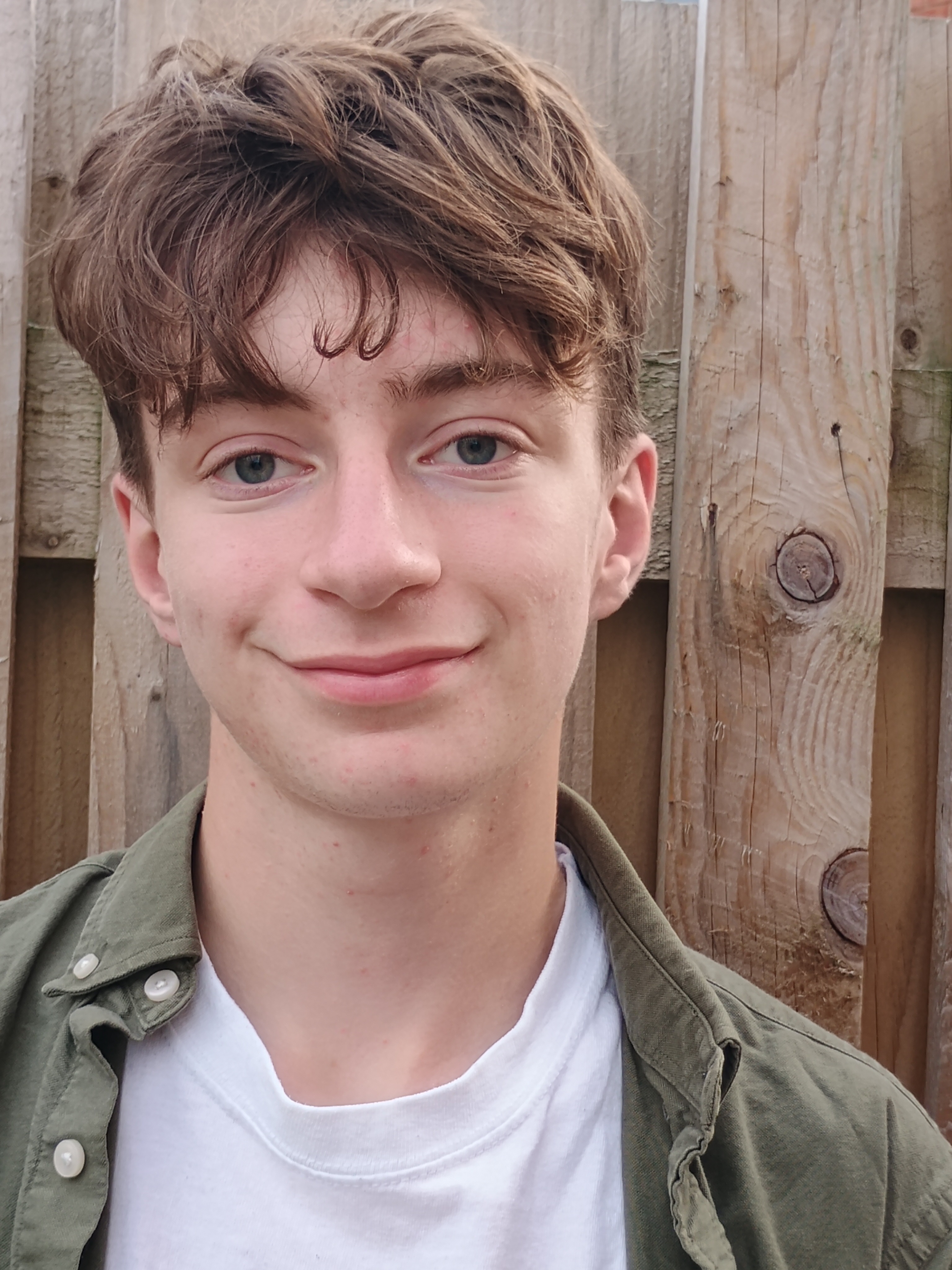
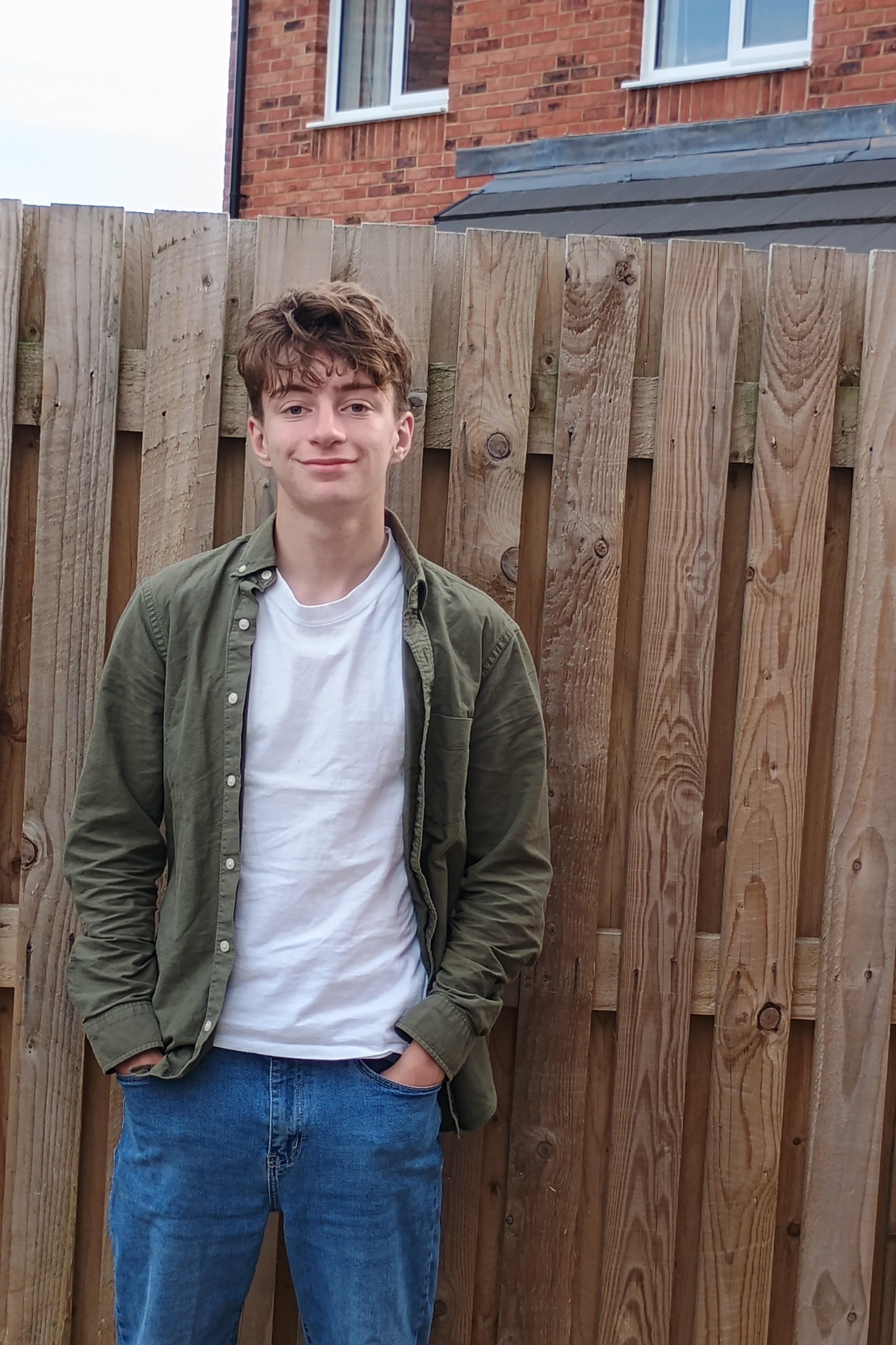
Based in Cumbria. Comedy and drama, in front of and behind the camera.
Lead Actor, Co-Writer, Co-Producer — Unit 8, Level 3 Film Production & Media
Toasty is an absurd comedy short set in a world where cheese has been criminalised like a Class A drug. I played Dave, a man whose cheese addiction spirals into increasingly ridiculous situations, while co-writing the script and co-producing the shoot alongside a five-person crew.
The film premiered to a full cinema audience of around 300 people on 10th June 2026, where it won Best Picture and I won Best Actor at Gateway Arts Festival 2026, Kendal College Film Production's own festival, spanning both first and second-year students and their cast, judged across categories including Best Picture, Best Director and Best Actor.
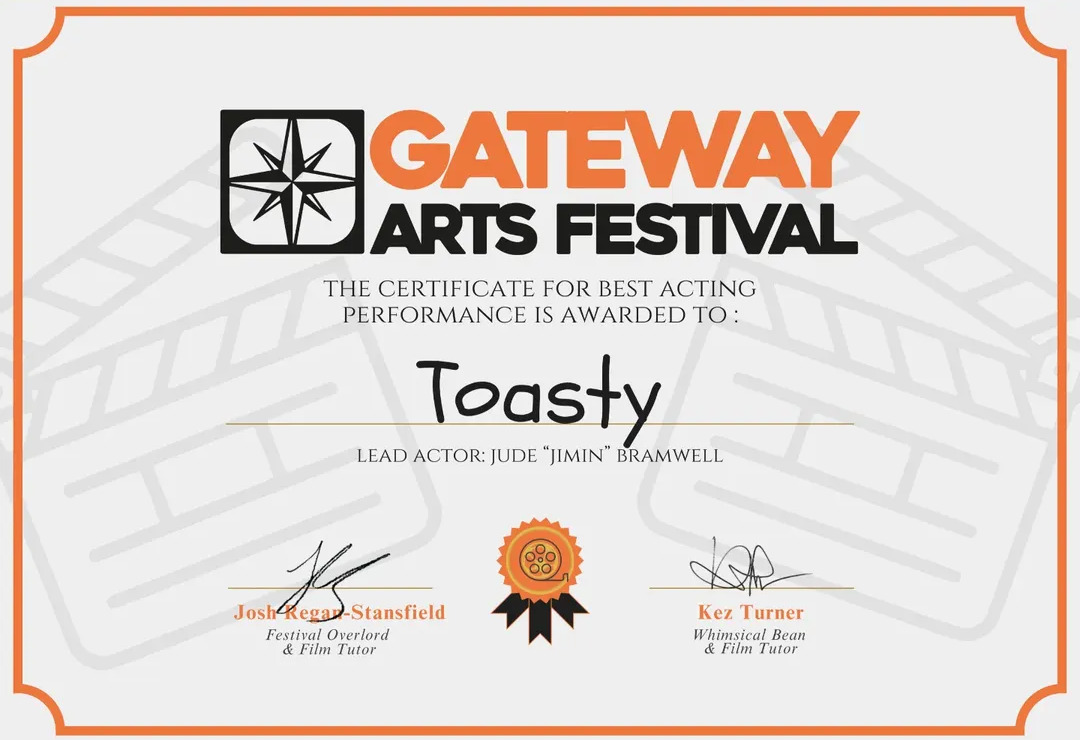
Full film, 15 min.
The film's biggest reaction came at the premiere, where it went on to win Best Picture and Best Actor. Before that, at an earlier rough cut screening to our Year 1 group, the film scored 4.47/5 overall from test audience feedback, with 40% of people naming my performance a highlight in both the "favourite scene" and "funniest moment" questions.
As co-writer, I helped shape the script from first draft through to final cut, including writing and improvising the bathroom confrontation scene, a moment praised at every stage of production, from a peer's script annotation, to a visiting professional editor, to the test audience itself.
As co-producer, I ran four location recces, rewrote the risk assessment from scratch, and produced the call sheet for our reshoot, going from not knowing what either of those things were, to running them myself.
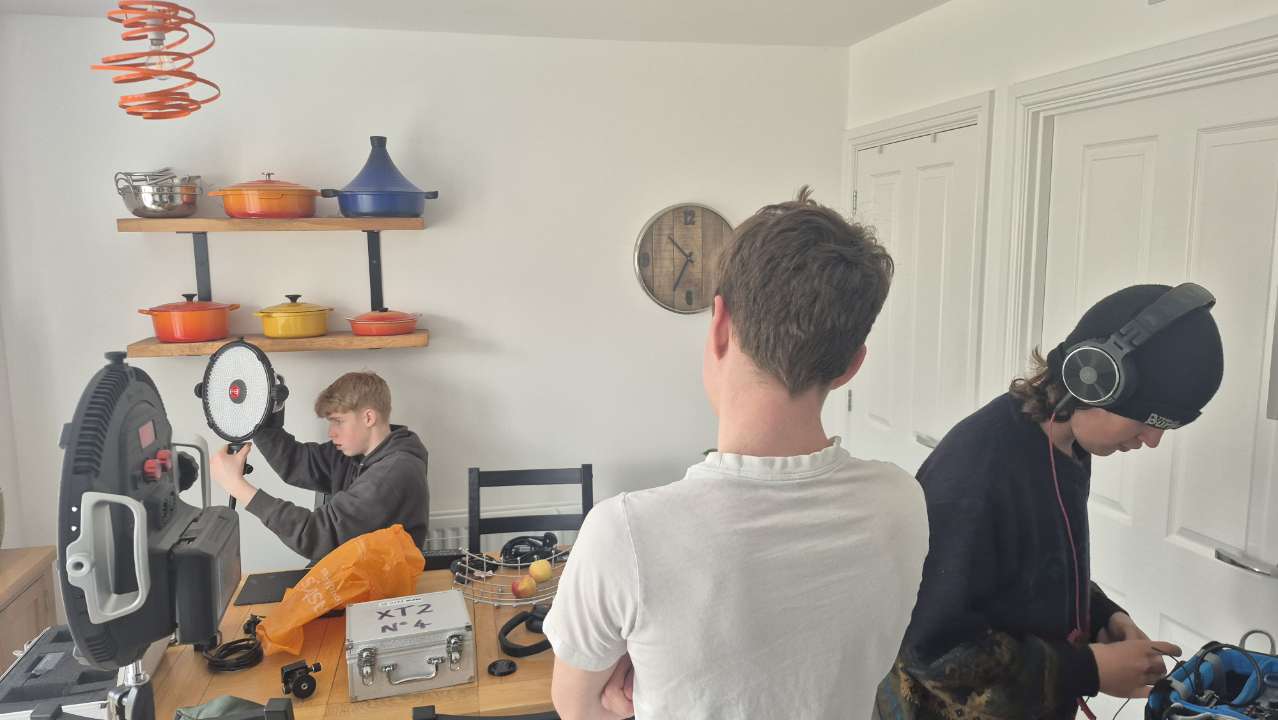
Toasty is the clearest evidence I have of combining performance with the production and writing skills I want to build a career on.
by Morris Panych — Actor, one-to-one coaching with Helen Openshaw, Eden Valley School of Speech and Drama, February 2026
This was my first serious dramatic piece working one-to-one with my drama coach, Helen. After a session assessing my strengths, we identified that while I had strong comedic instincts and experience, building range into more serious, dramatic work would stretch my acting further.
Helen selected an excerpt from 7 Stories, a dark comedy by Canadian playwright Morris Panych, in which a man on a building ledge, contemplating jumping, unravels into a spiralling monologue about time, identity, and control, recounting a memory of ramming his car into another driver's over a parking space.
We worked through the script line by line, marking up where to place emphasis and where to pause, testing different deliveries through trial and error. Because the character speaks slowly and deliberately, much of the work was about control: learning to slow down, sit in pauses, and use my face more precisely. I naturally smile when I speak, which actually worked in this piece's favour, giving the character an unsettling, off-kilter energy that suited someone clearly unravelling.
Alongside performance, we planned the camera work scene by scene. As the character sits pondering, the camera holds still. A pause marks his big realisation, then as he says "and so I got up," a tracking shot follows him pacing. A close-up settles on my hands as the character fixates on their "amazing dexterity." As he delivers his final line about his hat "forming a firm idea around my head," he stops, gestures to his head, and sits. The camera slowly zooms in as he turns to address it directly for the rest of the piece.
This was the first time I built a character entirely outside comedy, learning to control pace, stillness, and expression rather than lean on instinct alone.
Writer, Actor — one-to-one coaching with Helen Openshaw, Eden Valley School of Speech and Drama, April–June 2026
For this piece, Helen and I set out to write something serious from the ground up. We developed a character together: a young WW1 soldier who joined the army to prove himself to his father, only for it to backfire completely. Helen played sounds of bombs and gunfire while I wrote the script itself: five lines beginning "I thought," five beginning "They told us," five beginning "I remember," and five beginning "I can still hear." Writing to that repeating structure, against the sound of war, shaped the piece into something that builds in intensity rather than just describing it.
I played the character with a deliberate frown and a lower, downward vocal pitch, letting sentences fall rather than lift, to carry the sadness in the writing itself. Each section has its own distinct emotional register: reflective and heavy through "I thought"; building anger through "They told us," where the character eventually stands and mutters "they told us they were human too, but how, how could I believe them"; softer and more sad through "I remember," including a slight smile on a happier memory before it turns dark again; and jumpier, more unsettled through "I can still hear," his eyes darting and body jumping slightly, suggesting he genuinely still hears the bombs.
The piece ends with the character struggling to hold eye contact with the camera, before finally locking eyes with it directly and intensely to deliver the final line: "Of what was to come."
Filmed in a WW1 uniform, jacket and Brodie helmet, against a sandbag-dressed set, giving the performance a grounded, physical sense of place rather than existing only as a monologue to camera.
The clearest evidence I have of writing and performing dramatic material together, skills that speak directly to acting, and to any role built on making a story people actually feel. Helen has since told me she plans to use the script in lessons with other students.
Arts Award Bronze (pending) — Script Contributor, Directing Support & Boom Operator, Signal Film & Media, 2025/26
Watch "One Click" in full on Vimeo (Signal Film & Media) →
The BFI Film Academy is a short course run through Signal Film & Media, working toward a BFI Arts Award. As part of a production team, I helped make One Click, a sci-fi comedy-thriller about a film editor swamped by deadlines who's tempted into handing his job over to AI. My main focus was on dialogue and operating the boom microphone during filming, staying alert through every take and adapting quickly whenever something changed on set, and I also took on a directing role for one scene.
One scene tested me more than I expected: a basement shot needed a fan spun continuously to cast a moving shadow on the wall, the speed and rhythm held exactly consistent for the whole take. Keeping that rhythm steady, without stopping, taught me how much precision sits behind even the smallest production details.
I explored how the same written dialogue can land completely differently depending on direction. I wrote two speeches for a scene in which an AI character, Ellie, tries to persuade someone to click a button that will turn him into an AI, then worked with an actor across contrasting deliveries: one ranging from cocky and belittling to slow, nagging, the other from softly convincing to seductive to quietly sinister. The actor said afterwards that my direction was clear and easy to work with.
Watch Ellie's speech in the final cut (7:25–7:57) →
The same script came out almost comedic in one version, genuinely unsettling in another. The final edit actually blends elements of both directions rather than picking one outright, proof of my own range across writing, directing, and adapting to different roles within a production.
Full stats, skills and credits are in the downloadable CVs below.